Publications
Veuillez-vous connecter pour avoir accès
à vos informations pour les
membres
Procédures d'affaire, Restructuration
The Value Methodology, the oldest, most complete process for identifying problems or improvement opportunities in products, processes or services, has not been adopted nor does it enjoy the visibility of the more popular management tools in today's competitive environment. Total Quality Management, Theory of Constraints, Quality Function Deployment, Design of Experiments, Design for Manufacturing/Assembly, TRIZ, Target Costing, Lean Manufacturing, Six Sigma, etc., are a few of the tools being employed by organizations to resolve problems and improve their bottom line. While these tools may work well within their focus, many lack the broad scope necessary to resolve the overall business concern.
This paper will provide a brief survey of these tools and how they relate to the Value Methodology Job Plan. In many instances the most beneficial management approach would be to employ the value methodology as an overarching approach to addressing management concerns and inserting the appropriate tool when conditions warrant.
Measuring and capturing results throughout business transformation is essential, but it’s not just about metrics and measurement. In KPMG’s experience, the achievement and sustainment of expenditure reductions and enterprise wide change is maximized when performance management is embedded in the transformation governance model. KPMG’s Value Management approach is designed to meet these critical requirements, leveraging global, collective insight (in the form of trends, value drivers, reference models, benchmarks, and leading practices) to accelerate and sustain business transformation.
- The translation of transformation actions into outcomes, qualitatively documented in the form of value models and quantitatively justified in a “value case”;
- The measurement and reporting of benefits starting with baseline measurements; and
- The incorporation of “value” into the program governance and decision-making (roles, accountabilities, scope, risks, mitigating actions).
Many organizations face a long list of projects ahead without an effective way to make decisions on which projects should receive resources. This study shows how detailed function analysis through the effective use of functional performance specification techniques in a workshop can be used to help a multi-divisional team work across business lines. The study established a number of key performance indicators that could be used to prioritize expenditure and workload resource decisions.
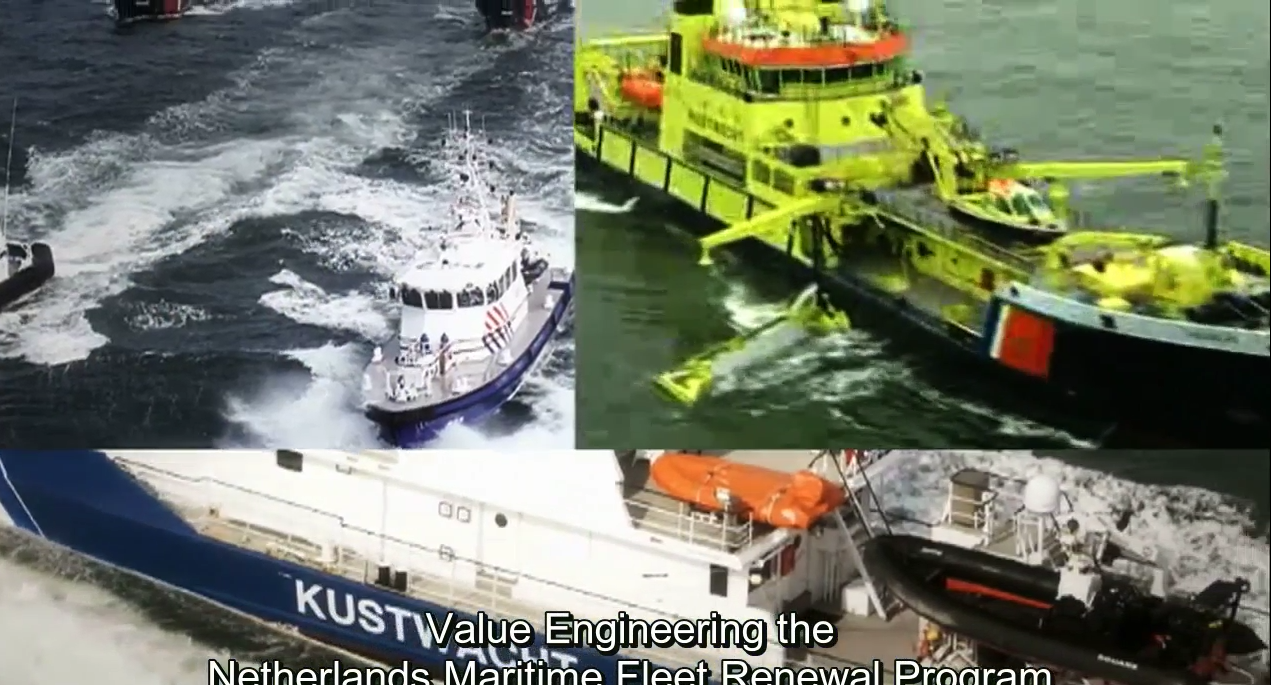
The area of application and scale of this case are somewhat unusual: how can four ministries and a shipping company optimise the utilization of their 12 sea vessels and reduce that number?,Design for Value model was used resulting in VE-workshops in which the fifty participants developed and agreed on how to reduce the number of ships while improving performance for their business and organizations.
Download Presentation
Unfortunately the full Value potential is not realised. To reach this potential, three aspects need to be addressed: 1) timing of the Value-interventions, 2) implementation of results and 3) a continuous focus on Value throughout the project-lifecycle, looking at a project from a business goal perspective.
The management of Value needs to be an integral part of the project. Therefore we introduce Value Control as an addition to the Value Management Framework. In this paper we will first explain the ProRail context, then describe the research-results and finally introduce our proposal for Value
Control.
The Calgary Fire Department was faced with a critical decision: What needs to be done with Fire Stations 1 and 2 to maintain fire service readiness in the downtown core? The Department operates three fire stations in downtown core and two of the stations are approaching end of life. Should the stations be replaced? Should the stations be renovated, or combined? What about augmenting them with a new station on vacant land or integrated into other buildings? Lots of opportunities! Almost too many?
An innovative approach was used to address the fundamental question: value management. In doing so, the Department reset its perspective from just looking at the infrastructure needs of specific stations to a broader review of its overall fire service strategy in the downtown core. This also enabled consideration of a range of potential strategic and infrastructure opportunities, as well as other Citywide initiatives involving collaboration between and co-location of other City Departments.
This presentation provides an overview of the value process and presents several key strategies used by the City to explore the opportunities to maintain and enhance fire service in downtown Calgary.
The City of Calgary had identified a need to replace or renew some downtown fire stations. This presentation shows to asset managers the application of Value Management to develop a strategic asset management plan.
Plusieurs entreprises, qu’elles soient privées ou publiques, font face à des portefeuilles de projets bien remplis. La priorisation de ces projets n’est pas toujours aisée. Pourtant, il s’agit d’identifier quels projets auront du financement et des ressources et lesquels devront attendre ou carrément être éliminés. Il arrive aussi que ces projets soient tellement diversifiés qu’il est difficile de trouver des points communs sur lesquels seront basés les choix.
La valeur que ces projets apporteront à l’entreprise est le critère qui permet de comparer les projets entre eux. La présentation porte sur comment identifier et mesurer la valeur des projets et comment s’en servir pour les prioriser. Un exemple vécu est utilisé pour illustrer le propos.
The VA/VE methodology has been used successfully for the past 70 years yet it is only being utilized in some business and government sectors, in North America. Traditionally VA/VE was used in the manufacturing sector but this methodology been proven to be successful in many environments including capital projects, business process and IT projects, in the public and private sectors.
It has always been a mystery to me that the VM methodology has remained largely a project-focused, problem-solving tool rather than an executive boardroom tool.
This presentation discusses how the Value Management can be utilized more effectively at the corporate level to assist in the decision making process in:
- Strategic planning
- Capital planning
- Human Resource planning
- Client satisfaction
- Risk Management
Ah, les décisions. Quelle que soit l’industrie dans laquelle vous évoluez, les décisions à prendre ne manquent pas, grosses et petites. On a souvent l’impression d’être en train de jongler, avec tant de facteurs à prendre en considération. Lorsqu’on évalue les solutions, l’un des ingrédients clés du processus décisionnel est la valeur. Cette présentation illustrera quelques exemples de la manière dont Enbridge a appliqué des éléments de la méthodologie de la valeur à divers types de décisions d’affaires.
Conférencier
Michael Tozer, ing., VMA, Enbridge Pipelines Inc.
Mike Tozer est un spécialiste de la gestion de la valeur et fait partie du groupe de gestion de la valeur d’Enbridge depuis sa création en octobre 2016. Dans ce rôle, il s’est principalement concentré sur l’établissement d’un cadre de gestion de la valeur pouvant être intégré de manière durable dans l’organisation. Pour mener à bien cet objectif, Mike a obtenu son titre d’associé en méthodologie de la valeur (VMA) de SAVE International en 2017, et a été élu au conseil d’administration d’Analyse de la valeur Canada en 2019. Sa carrière chez Enbridge s’étend sur 18 ans et trois unités commerciales. Il a passé ses dix premières années en Ontario chez Enbridge Gas Distribution, où il a progressivement occupé des postes dans les domaines de l’intégrité, de l’exploitation, de l’ingénierie et de l’exécution de projets. Mike a ensuite déménagé en Alberta en 2013, où il a occupé divers rôles dans les domaines des grands projets et de la performance des actifs. Mike est un ingénieur qualifié dans les provinces de l’Alberta et de l’Ontario et a obtenu un diplôme en génie mécanique de l’Université du Nouveau-Brunswick. Il vit à Calgary avec sa femme et leurs quatre enfants.
The presentation will demonstrate the necessity of setting things up right from the outset in order to provide clear articulation of value priorities and avoid the destruction of value through avoidable mishaps.
The methods contained in MoV have been used in the health sector and other complex situations facing hard and soft issues.
Learning points:
The role of Managing Value in improving programme and project performance
How to set up programmes and projects right from the outset
The relationship of MoV to other commonly used techniques and processes
Case studies to demonstrate how the benefits of using MoV can be delivered
The key messages within MoV and the qualifications relating to it, in the context of other internationally available Value Management qualifications
As demand increased significantly in the last year, a metal powder manufacturing company had to quickly optimize the production capacity of the plant. At first, more than 200 ideas were generated from intensive brainstorming sessions. About 35 of them were retained for cost evaluation and preliminary engineering. Since the capital expenditure for those projects ranged from $20K to $2M, it was needed to identify those which had the highest gain to cost ratio although the expected returns could not be quantified with certitude.
By combining Value Engineering and the Paired Comparison Matrix techniques it was possible to identify projects that had a significant impact for the plant as well as meeting budget constraints. The scope of work has been approved, some plant modifications have been implemented and detailed engineering initiated for more complex issues.
*Première Mondiale*Basé sur la diversité des méthodes et techniques d’analyse (Analyse d’Affaires, Analyse de la Valeur et Design Thinking), issue de la recherche au sein de l’Université de la Valeur, Value Design Compass™ est une plateforme d’outils et de techniques qui permet de (re) concevoir des produits et services utiles et durables.
Également, lors de cette présentation, sera donner une définition de TVO (la valeur globale de possession).
Malheureusement, très peu comprennent vraiment le concept de valeur au-delà de la valeur financière. Alors, la question est : qu’est-ce-que la communauté valeur peut amener à cette discussion ?
Larry Miles a défini la valeur comme un rapport qualité/prix, à partir de là, le concept s’est élargi pour inclure Satisfaction des parties prenantes (clients) vs ressources nécessaires pour réaliser cette satisfaction. Plus récemment, les concepts de « Lean » ont ajouté l’idée du Flux de Valeur, qui consiste à éliminer le gaspillage dans la chaîne de value entre l’expression du besoin et sa satisfaction.
Au cours de cette présentation, je vais tenter de présenter un approche dynamique du VMO (Value Management Office ou Organisation) qui s’aligne avec le contexte actuel de complexité que vivent les organisations et l’historique de l’analyse de la valeur.

Des problèmes peuvent survenir, car tout au long de la vie d’un programme ou d’un projet, il peut y avoir plusieurs groupes de personnes impliquées ayant des compétences et des motivations différentes, des objectifs et des systèmes mal alignés, ainsi qu’une capacité d’adaptation variable aux changements potentiels. Le passage du témoin en matière de gestion se fait parfois à tâtons au cours des différentes étapes du cycle de vie d’un programme ou d’un projet.
La bonne gouvernance des dépenses majeures exige une clarté totale à travers une série de décisions critiques pour les choix cruciaux et au-delà. Un processus d’intégration bien structuré et à long terme est nécessaire pour guider l’établissement des priorités, l’investigation et l’analyse, le diagnostic, l’innovation, l’essai et l’affinage, la planification et l’assurance globale d’une réalisation complète et en temps voulu des bénéfices. L’alignement adéquat de perspectives et d’approches multiples, ainsi que la recherche d’une valeur ajoutée et d’une amélioration des performances, sont nécessaires à différents stades du programme et du projet.
En d’autres termes, nous devons nous assurer que nos grands projets d’investissement sont «?bien faits, du premier coup?» et au bon prix. Il est essentiel de se mettre sur la bonne voie et de rester sur la bonne voie à long terme.
Une approche globale de planification, d’optimisation et de garantie de la valeur sera décrite. La discussion sur les différents points de vue sera encouragée au cours de cette session.
Michel Thiry highlights how today's organizational context is rapidly becoming more complex and turbulent. He demonstrates that Strategic Value Management (VM) is ideally suited to support an organization's need to become more responsive to change and make informed business decisions.
VM is one of the most effective processes to help identify the needs and expectations of multiple stakeholders. Michel Thiry uses a Functional Performance Specification or Business Benefits Breakdown Structure technique to help business define their business needs in a systematic fashion. It is also an efficient group decision-making and problem-solving methodology that helps clarify a strategy and define the means to achieve it.
Michel expanded on his strategic value management overview with his keynote on Strategic Value Management which is available here:
A PMI paper on the business benefits of Strategic Value Management is available from PMI.
Information on the Functional Performance Specification Technique is available from VA Canada under VA in Depth.
The Ontario Ministry of Transportation is the leading government proponent for Value Engineering in Canada. The expanding use of and advocacy for Value Engineering by the Ontario Ministry of Transportation has occurred because Value Engineering meets 3 key needs:
1. Maximizes use of resources
2. Establishes common understand of business needs
3. Delivers Innovation
This paper will highlight how the Ontario Ministry of Transportation uses value management to achieve innovation in infrastructure projects, improve the effectiveness and efficiency of business processes, define the requirements of IT systems, generate organizational change, and develop innovative standards.
The presentation provides Lean practitioners information on Value Analysis and Function Analysis as a method to generate ideas in a Lean environment.